Intel's flagship annual technology and industry ecosystem conference, Intel Connection 2026, concluded at the Suzhou International Expo Center under the theme "Connected by Intelligence · Moving Toward the Future." The two-day event drew some 3,000 AI practitioners to 11 keynote speeches, 80+ technical sessions, and a 15,000-square-meter expo presenting more than 1,300 technology and application innovations across four experience zones: Enterprise AI, Industry AI, Physical AI, and Gaming, Home & Personal AI.
From Model Capability to
Large-Scale Deployment
This year's defining narrative was
Agentic AI — the shift from passive, prompt-driven AI
to autonomous agents that plan tasks, call tools, and execute end-to-end.
Conference data cited nearly 80% of global enterprises already piloting agent
technology, with more than 350 million active enterprise agents expected in
China by 2031.
Intel argued that this shift changes
data center architecture itself. The newly optimized Xeon 6+ processor can
stably host over 1,000 agents on a single chip and concurrently create 350
sandboxes with 200-millisecond launch latency — evidence, Intel executives said, that the intelligent data center of the agent
era must be CPU-centric, with CPU, GPU, IPU and storage working in concert,
rather than measured by raw GPU throughput alone. Intel CEO Lip-Bu Tan,
addressing the conference by video, pointed to x86 plus Intel's full
cloud-edge-device ecosystem as the foundation for the agentic era. An Intel 18A
advanced-process wafer was displayed for close-up viewing on the show floor.
Compute
Everywhere, Cooled Everywhere
Agentic PCs and edge terminals. Device makers unveiled the industry's transition from AI PCs to full "Agentic PCs" capable of 24/7 autonomous task execution. Emdoor showed Panther Lake-based AI mini-PCs and workstations delivering up to 180 TOPS with Intel NPU 5 (50 TOPS), magnesium and carbon-fiber ultralight AI laptops under 1 kg, and rugged AI tablets for field use. Six Union (Liulian Intelligent) launched the Agent Cube enterprise agent all-in-one machine alongside a full line of Agentic PCs built on Core Ultra and Xeon 6 platforms, pairing cloud "super-brain" models with local lightweight models for cost, latency and data-security balance.
Office-friendly token appliances. The
TBX16 token all-in-one machine, in an ORV3-standard chassis with 16 parallel
accelerator cards, runs out of the box in ordinary office environments with
fully local data loops — paired with Envicool's
full-chain liquid cooling rated at 18 kW at a quiet 55 dB. Supercloud (Sugon)
debuted the industry's first native immersion liquid-cooled AI inference
appliance (SUPERRACK-200-S), plus high-density Xeon 6 servers and heterogeneous
Granite Rapids-AP training systems.
Power-compute convergence. A
containerized energy-storage-compute integrated solution combined substations,
batteries and compute in a single standard container, converting nearby green
electricity directly into token production — a scalable
model for the next-generation "AI factory."
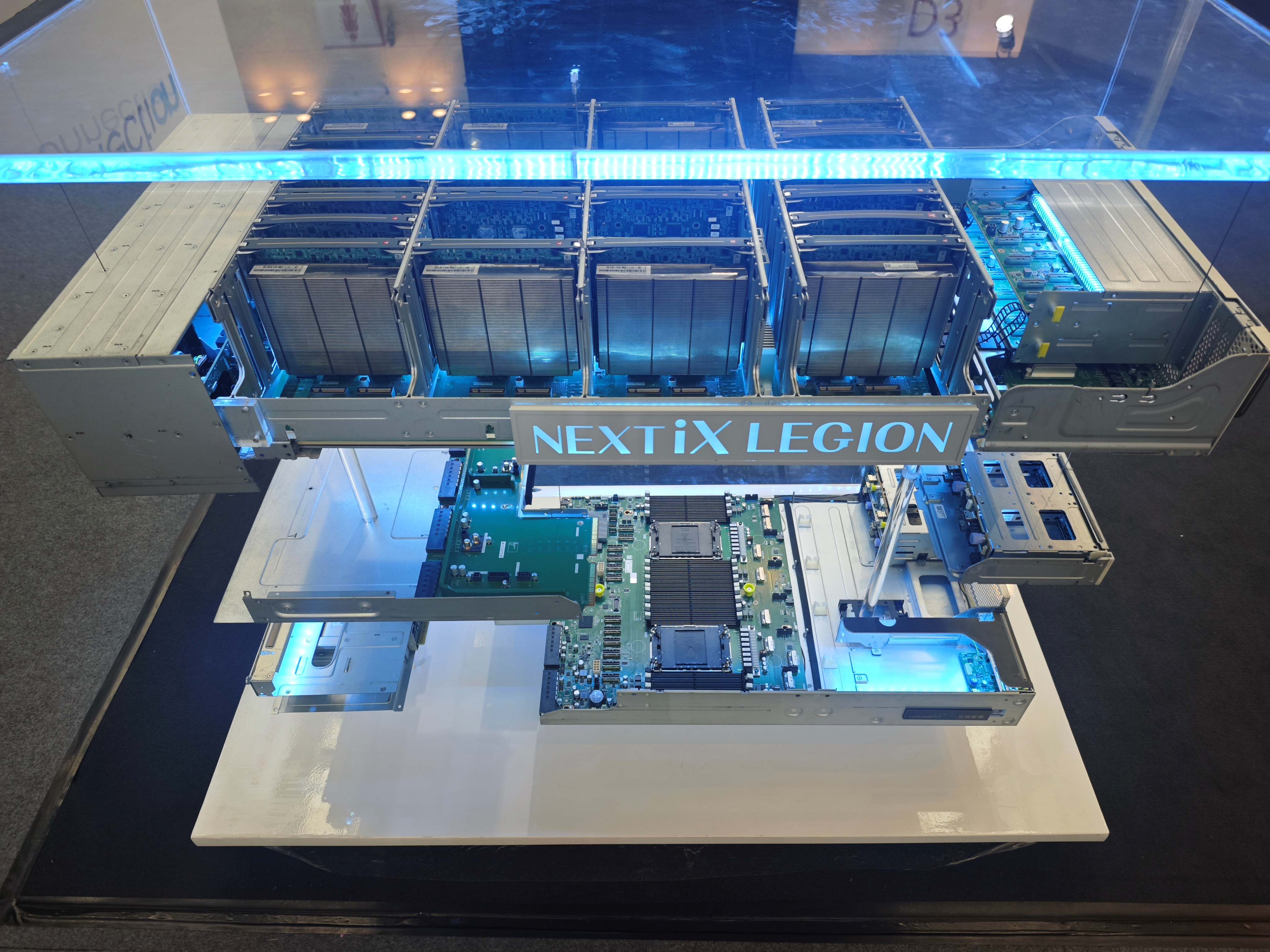
From servers to AI factories as a
platinum sponsor. Luxshare's intelligent-computing arm, NEXTiX, presented its
NEXTiX LEGION "legion" series of AI compute systems — six product lines (TITAN, APEX, NOVA, IRON, VORTEX, FALCON) built
on a unified iX Architecture and scaling from a single server to 10,000-GPU
clusters across large compute centers, core training, open heterogeneous,
enterprise AI, high-density compute and high-density liquid-cooling scenarios.
A show-floor comparison made the density gains tangible: two 8-card OAM
servers, one liquid-cooled in 2U versus 8U for air-cooled. Beyond hardware,
Luxshare demonstrated a three-step expansion from selling equipment to building
prefabricated modular data centers (power, cooling, compute, networking and storage
pre-integrated and debugged off-site, then deployed as modules) to offering GPU
compute leasing, pooling compute resources with remote monitoring and on-site
operations.
Why Suzhou
The choice of venue was itself a
statement. Suzhou is one of China's densest concentrations of manufacturing
scenarios — within dozens of kilometers of the expo
hall, every displayed chip, edge architecture and AI solution finds device
makers, rigorous test lines and paying industrial customers. Intel's local
roots run deep: an Intel–Nanjing University (Suzhou)
technology pilot center, equity stakes in local semiconductor firms, and a
newly established joint laboratory with Lingyi iTech, whose AIDC headquarters
and mass-production center landed in the city this August.
With the show floor spanning everything
from 18A wafers to immersion-cooled token factories and sub-kilogram AI
laptops, Intel Connection 2026 made one message unmistakable: the agentic AI
era will be won not by single-chip horsepower, but by an open, full-stack
ecosystem — and that ecosystem, increasingly, is being
built in and for the real economy.
